 Reject (the verb) is such a god-awful word and its literal definitions are downright depressing:
–To refuse to accept, submit to, believe, or make use of.
–To discard as defective or useless.
–To spit out or vomit.
It’s a shame that we use the word so liberally in the writing world. “Honey, I got another rejection today!”
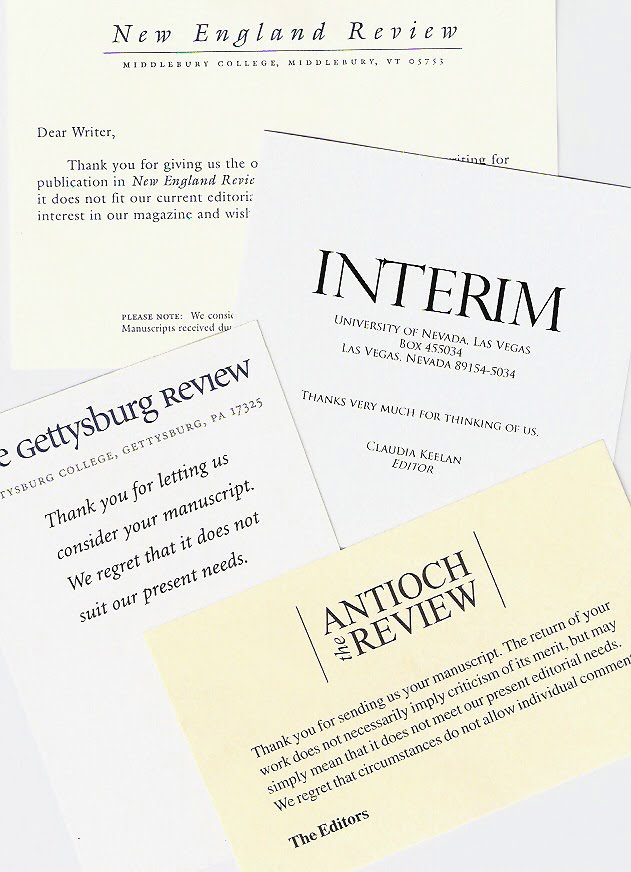
I know that journal editors are not vomiting my writing or saying it’s defective. How rude would that be! Yet, they aren’t saying much when they send the generic note card or half slip of paper that looks like it’s been photocopied a thousand times. Sure, some of those note cards are mighty fancy and would be something to ooh and ahh over if they were party invitations and not the bearers of bad news.

In five months, my “no” pile has grown to 36 and my “yes” pile is a lonely one acceptance. The good news is that those 36 rejections (no thank-yous) were for 13 different pieces. A published author I know said not to dare complain about rejection until one piece has been turned down 10, 20, 40 times. Some of my short stories and essays have only received 2, 3, and 4 rejections. I’ll hold the tears for now.

The best news is that from time to time you’ll actually hear from a real live person who reads your work and responds with feedback that will help you improve the piece. I submitted a short fiction piece to Our Stories literary magazine. Today, I received a critique from an editor. Below is a short excerpt from her much longer review:
As you have noticed, I hardly made any corrections throughout the text: your prose is really clear and beautiful; the voice sucks you in and doesn’t let go till the end. Right now, however, this entry has a feel of an exercise in the character’s background, voice and working out of the mother-daughter relationship dynamics, rather than a complete short story. The dramatic arc is lacking in the present. There is a slow reveal of information, but it has minimal effect on characters in the current set-up. So, given these wonderful, fully-formed, complex characters with distinctive voices and personal histories, launch them into a real story, while keeping all of the other info in either flashbacks or exposition or – in part – in the bride’s thoughts.
Eureka! This gives me something to chew on. I get what she’s saying and have tangible advice to guide my revision. That kind of “rejection” motivates me to rewrite rather than turn to chocolate ice cream. Hurray for these kinds of days in a writer’s life.