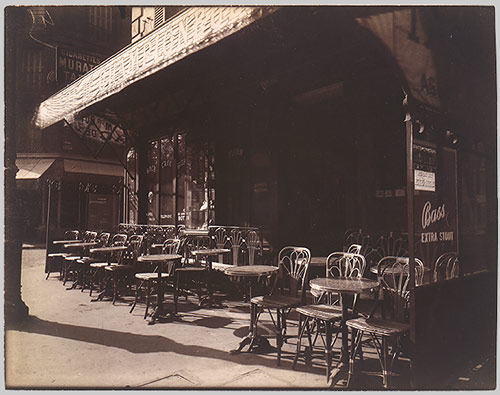
 On July 4th, my nephew and I saw a movie while the rest of the family golfed. I chose “Midnight in Paris,” Woody Allen’s new movie, because it was at the local theatre with the best popcorn. While a bit sentimental, the film still held a lot of charm in the way it demonstrated the age-old illusion people have that a life different than theirs would somehow be better.
The movie’s main character, a writer, “time travels” each midnight to his idea of the golden age: 1920s Paris. He rubs shoulders with F. Scott and Zelda Fitzgerald, Picasso, Hemingway, Dali, Gertrude Stein and others. These excursions are his escape from a wholly unsatisfying life as a Hollywood screenwriter to a romantic, creative era more conducive to the arts and writing.
He meets an alluring woman during one of these late night adventures. She finds 1920s Paris boring and is looking for her own golden age, which turns out to be the 1880s in Paris, the age of Gauguin, Rousseau, Degas and Monet.
In the end, he realizes he’s the architect of his present; he can make it whatever he wants it to be. He breaks up with his fiancé and stays on in Paris to write his novel.
It’s only human to want something better for ourselves. And I don’t think that’s wrong. What gets us in trouble is thinking that the “something better” exists elsewhere. It’s always within reach because the something better is in us, right there for the taking.
Yes, writing my novel at a little cafe in Paris sounds idyllic, but it’s also expensive. I kind of like that I can find inspiration right here in little Durango at one of the many little coffee houses.
Leave a Reply